
Planning a move in California sounds simple at first. You call to get a quote and suddenly a moving broker steps in to handle everything for you. But pause for a second. The FBI has warned about moving scams where some brokers jack up prices and even hold belongings hostage until you pay. Most people expect a broker to make things easier but sometimes using a middleman introduces risks you would never guess at first glance.
| Takeaway | Explanation |
|---|---|
| Understand the Broker’s Role | A moving broker connects customers with licensed carriers but does not perform physical moves. |
| Verify Broker Credentials | Ensure the broker is licensed and has proper insurance before engaging their services. |
| Request Detailed Estimates | Obtain written estimates to avoid unexpected charges after booking. |
| Recognize Potential Risks | Be aware of fraudulent practices such as hidden fees and price hikes. |
| Evaluate Service Quality | Assess customer reviews and company reputation to find a reliable moving partner. |
Moving can be a complex process, and many people are unfamiliar with the role of moving brokers in the relocation industry. According to the Federal Motor Carrier Safety Administration, a moving broker is a professional intermediary who arranges transportation of household goods by connecting customers with licensed moving carriers, without actually performing the physical move themselves.
Moving brokers act as facilitators in the relocation process, serving as a critical link between customers and professional moving companies. Their primary responsibility is to match customers with appropriate moving carriers that can meet specific transportation needs. Unlike direct moving companies, brokers do not own trucks or employ moving personnel. Instead, they leverage their network of transportation providers to find the most suitable moving solution for each client.
The Legal Information Institute defines a household goods broker as a person or entity that sells, negotiates, or arranges transportation of household goods by motor carriers for compensation. This definition underscores the broker’s role as a professional matchmaker in the moving industry.
While moving brokers can simplify the moving process, consumers must remain vigilant. The FBI warns about potential fraudulent practices in the moving brokerage industry. Some unscrupulous brokers might provide low initial estimates and then dramatically increase prices after goods are loaded, sometimes even holding possessions hostage until inflated fees are paid.
To protect yourself, it is crucial to:
Moving brokers can be valuable partners in your relocation journey when you approach the relationship with proper research and due diligence. Learn more about selecting reliable moving services to ensure a smooth and stress-free move.
Understanding the fundamental differences between moving brokers and moving companies is crucial for anyone planning a relocation. While they may seem similar on the surface, these two entities play distinctly different roles in the moving process.
Moving companies are direct service providers with their own fleet of trucks, professional moving crews, and equipment. They handle the entire moving process from start to finish, including loading, transportation, and unloading of household goods. According to the American Moving and Storage Association, these companies employ trained professionals who physically execute the move and are directly responsible for the safety and handling of your belongings.
In contrast, moving brokers operate more like intermediary agents. The Federal Motor Carrier Safety Administration explains that brokers do not own moving equipment or employ moving personnel. Instead, they act as matchmakers, connecting customers with licensed moving carriers who will perform the actual transportation and physical moving services.
The legal and financial responsibilities differ significantly between moving brokers and moving companies. Moving companies are directly accountable for the goods they transport. They must provide insurance, handle claims, and bear responsibility for any damage or loss during the move. The Transportation Intermediaries Association notes that moving brokers primarily facilitate the connection and are not legally responsible for the physical transportation or potential damages.
This distinction means that when you work with a moving broker, you are essentially hiring a service that will find a moving company for you, while with a direct moving company, you are hiring the actual transportation provider. The broker’s compensation comes from successfully matching you with a moving carrier, typically earning a commission or fee for their matchmaking services.
Pricing structures also vary between moving brokers and moving companies. Moving companies typically provide direct, comprehensive estimates based on the specific details of your move. These estimates are usually more precise and include a detailed breakdown of services and potential costs. The Better Business Bureau recommends getting multiple in-home estimates to ensure accuracy.
Moving brokers, however, often provide initial estimates that may not reflect the final cost. Since they are not the actual service providers, their initial quotes can be less reliable and may change once a specific moving carrier is selected. This variability underscores the importance of thoroughly understanding the terms and getting comprehensive information before committing to a broker’s services.
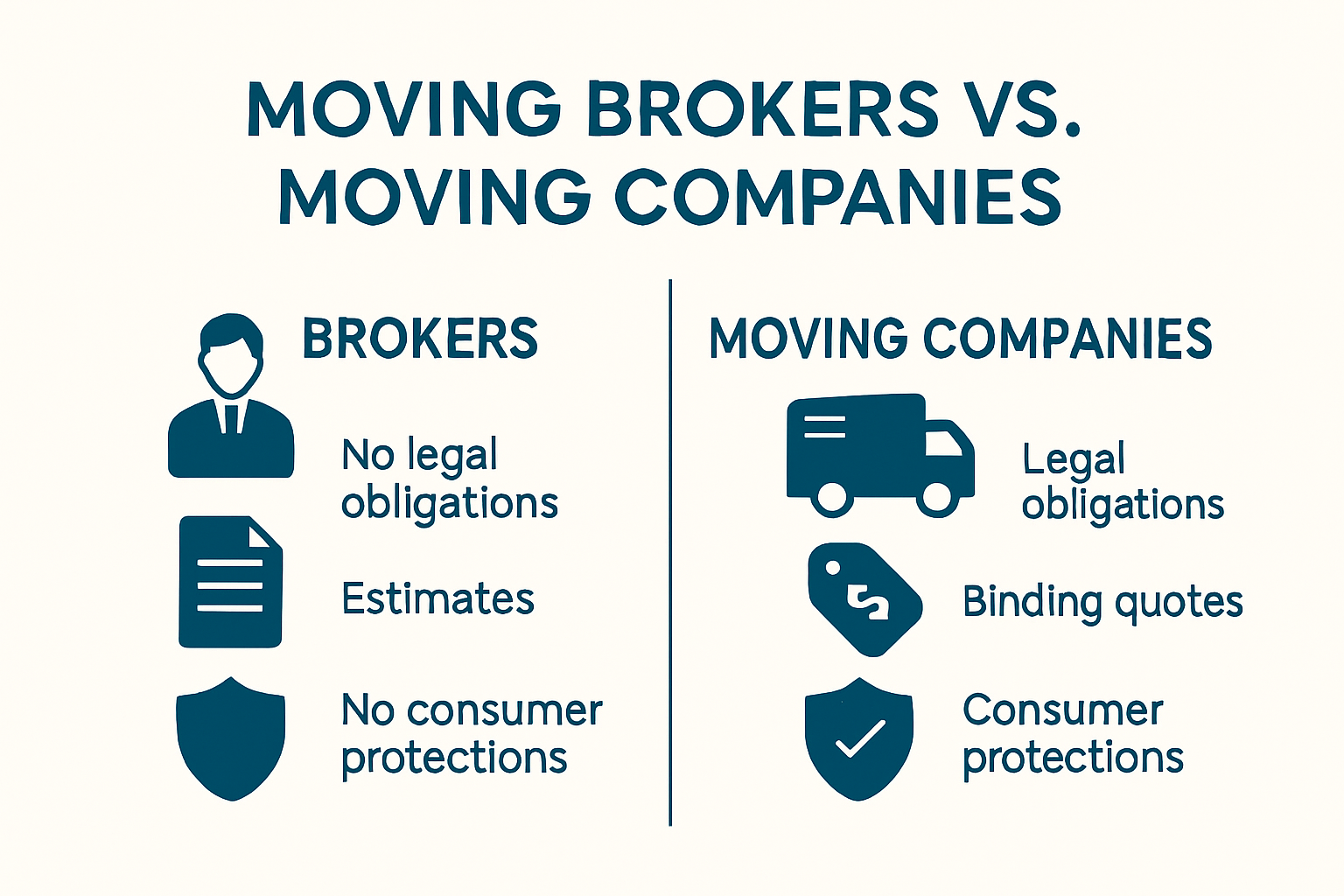
Explore our comprehensive moving services to understand the nuanced differences and make an informed decision about your upcoming move. Knowing these distinctions can help you choose the most appropriate service for your specific relocation needs.
To clarify the differences between moving brokers and moving companies, the following comparison table summarizes their main features and responsibilities.
| Feature | Moving Broker | Moving Company |
|---|---|---|
| Physical Moving Services | No (acts as intermediary) | Yes (owns trucks, hires movers) |
| Provides Written Estimates | Often provides initial, sometimes less reliable quotes | Provides detailed and typically more accurate quotes |
| Legal Responsibility | Not responsible for transport/damages | Directly responsible for goods and damages |
| Licenses & Credentials | Must be licensed (FMCSA, CPUC, USDOT) | Must be licensed, insured, and may hold certifications |
| Handles Claims | No | Yes |
| Owns Equipment | No | Yes |
| Compensation | Earns commission/fee for matching | Earns fees for performing the move |
Moving brokers can offer unique advantages and potential challenges for various types of relocations. Understanding these nuanced benefits and risks helps consumers make informed decisions tailored to their specific moving requirements.
For individuals and families planning residential moves, moving brokers can provide flexible solutions across different relocation scales. The California Department of Consumer Affairs emphasizes that consumers have critical protections, including the right to receive a ‘not-to-exceed’ price agreement and file claims for potential damages within nine months of the move.
Benefits for residential moves include access to a broader network of moving carriers, potentially competitive pricing, and simplified coordination. However, risks involve potential price fluctuations and less direct accountability. A Senate hearing investigation revealed that some moving brokers engage in deceptive practices, such as providing initially low estimates without comprehensive visual inspections, which can lead to significant unexpected costs.
Commercial moves present unique challenges that can benefit from a broker’s specialized networking capabilities. Businesses often require complex logistical arrangements involving multiple locations, specialized equipment, or time-sensitive transitions. Moving brokers can leverage their extensive carrier networks to find carriers with specific industry expertise or equipment requirements.
However, businesses must carefully evaluate potential risks. The complexity of commercial moves means that miscommunication or carrier mismatches can result in operational disruptions. Companies should request detailed carrier credentials, comprehensive insurance documentation, and explicit service level agreements to mitigate potential complications.
Specialized moves, such as interstate or cross-country relocations, represent scenarios where moving brokers can provide significant value. These moves often require intricate coordination, compliance with interstate transportation regulations, and navigation of complex logistical challenges.
Moving brokers can streamline the process by connecting clients with carriers experienced in long-distance transportation. Check out our guide on cross-country moving strategies to understand the nuanced considerations for complex relocations. While brokers offer convenience, consumers must remain vigilant about potential hidden fees, carrier qualifications, and comprehensive insurance coverage.
Ultimately, the decision to use a moving broker depends on individual needs, risk tolerance, and specific moving requirements. Thorough research, clear communication, and understanding of potential benefits and risks are essential for a successful relocation experience.
Selecting the right moving partner is a critical decision for Californians planning relocation. The complex landscape of moving services requires careful consideration and strategic evaluation to ensure a smooth, reliable, and cost-effective moving experience.
The California Department of Justice advises consumers to conduct thorough due diligence before selecting a moving partner. This includes verifying that the moving company or broker is properly registered with the California Public Utilities Commission for intrastate moves or the U.S. Department of Transportation for interstate relocations.
Critical steps in credential verification include:
The American Moving & Storage Association established the ProMover certification program, which provides consumers with a reliable benchmark for identifying reputable moving professionals. Companies with this certification have passed annual criminal background checks and committed to maintaining high ethical standards in their business practices.
Moving.com recommends obtaining multiple in-person estimates to ensure accurate pricing and avoid potential hidden costs. Californians should be cautious of moving partners who:
Transparency in pricing is crucial. Consumers should request detailed breakdowns of all potential charges, including:
When evaluating moving partners, it is important to verify their credentials and avoid red flags. The checklist below summarizes key verification steps and warning signs based on the article’s recommendations.
| Verification Step | Recommended Action / Warning Sign |
|---|---|
| Verify Active Licensing | Check with FMCSA or CPUC |
| Confirm Insurance Coverage | Ask for proof from the company |
| Review Professional Certifications | Look for ProMover or similar credentials |
| Request In-Person Estimate | Avoid companies giving estimates without a visit |
| Avoid Large Upfront Cash Deposits | Do not pay large sums before move |
| Check for Physical Business Address | Avoid companies lacking a verifiable address |
| Assess Moving Trucks | Prefer company-owned vehicles |
| Read Reviews and Assess Reputation | Look up customer reviews and company history |
Beyond credentials and pricing, Californians should assess the overall service quality and reliability of their potential moving partner. Learn more about professional moving strategies to make an informed decision that aligns with your specific relocation needs.
Key factors to consider include:

Ultimately, choosing the right moving partner requires a holistic approach that balances cost, credibility, service quality, and individual relocation requirements. Californians who invest time in thorough research and comparative evaluation are more likely to experience a seamless and stress-free moving process.
A moving broker acts as an intermediary who connects customers with licensed moving companies, but does not physically handle the move themselves.
Moving brokers facilitate the connection to moving companies and do not own the transportation equipment, whereas moving companies own their trucks and employ movers to handle the physical moving process.
Potential risks include hidden fees, price increases after booking, and the possibility of dealing with fraudulent brokers who may hold belongings hostage until additional fees are paid.
You can verify a moving broker’s credentials by checking their licensing with the Federal Motor Carrier Safety Administration (FMCSA) or the California Public Utilities Commission (CPUC) and reviewing their insurance coverage and customer reviews.
Worried about hidden fees or unreliable moving brokers who do not deliver on their promises? If you find yourself questioning who to trust with your next relocation in California, you are not alone. Many people in your position are looking for transparent, licensed movers who can offer clear estimates and genuine accountability throughout every step of the process. That is where US Pro Logistics can help bridge the gap and eliminate your stress.

Take control of your move today by choosing a professional team that values your peace of mind. Visit our main website for straightforward quotes and real customer testimonials, or explore our full range of moving solutions here. Let us show you what personalized, ethical support looks like, whether you are moving across town or preparing for a long-distance transition. Get started now for a secure, hassle-free relocation experience.
USDOT 3664256 This number is required for any company that operates commercial vehicles in interstate commerce (across state lines). It helps identify and track the safety performance and compliance of transportation companies.
MC 1268070 This number is specifically for companies involved in the transportation of goods or passengers for hire across state lines. It’s necessary for carriers operating in the moving industry and ensures they are authorized to operate as interstate carriers.

