
More than half of employees say corporate moving is one of the most stressful changes at work. When businesses relocate their offices or entire teams, the process can disrupt daily operations, stretch budgets, and test employee morale. A successful move shapes the future of a company by protecting productivity and keeping people engaged. Understanding the challenges and planning ahead helps organizations turn complex moves into smooth, well-managed transitions.
| Point | Details |
|---|---|
| Strategic Planning is Crucial | Corporate moving requires meticulous planning and execution to maintain operational continuity while minimizing employee disruption. |
| Understand Different Relocation Types | Recognizing the nuances of intrastate, interstate, and variation-based relocations aids in addressing the specific challenges and objectives involved. |
| Legal and Regulatory Compliance | Ensuring compliance with legal standards, data protection, and insurance requirements is vital to protect both organizational and employee interests during relocation. |
| Avoid Common Pitfalls | Businesses should proactively address common moving mistakes, like inadequate planning and poor communication, to facilitate a smooth transition for all stakeholders. |
Corporate moving represents a complex strategic process of physically relocating an organization’s workforce, equipment, and operational infrastructure from one geographic location to another. Unlike residential moves, corporate relocations involve intricate planning, substantial logistical coordination, and significant financial investments that can dramatically impact a company’s operational continuity and employee experience.
According to the GSA, employee relocation is a “powerful tool to help agencies recruit, retain, and develop a talented workforce” - yet simultaneously recognized as “a complex and stressful process”. This nuanced perspective highlights the multifaceted nature of corporate moving, which extends far beyond simply transporting physical assets.
Corporate moves typically encompass several critical components:
The HHS further emphasizes that effective moving processes require “expert guidance and comprehensive labor solutions” to manage the complex transfer of personal property, office items, and equipment. This underscores the importance of partnering with professional moving services that understand the intricate dynamics of corporate relocations.
Businesses undertaking corporate moves must recognize that successful transitions are not just about physical transportation, but about maintaining operational momentum, preserving organizational culture, and strategically positioning the company for future growth. A well-executed corporate move can transform potential logistical challenges into opportunities for enhanced efficiency, employee engagement, and organizational adaptability.
By approaching corporate moving as a comprehensive strategic initiative rather than a mere logistical task, organizations can mitigate risks, minimize downtime, and create a seamless transition that supports long-term business objectives. Our guide to the office relocation process provides deeper insights into navigating these complex transitions effectively.
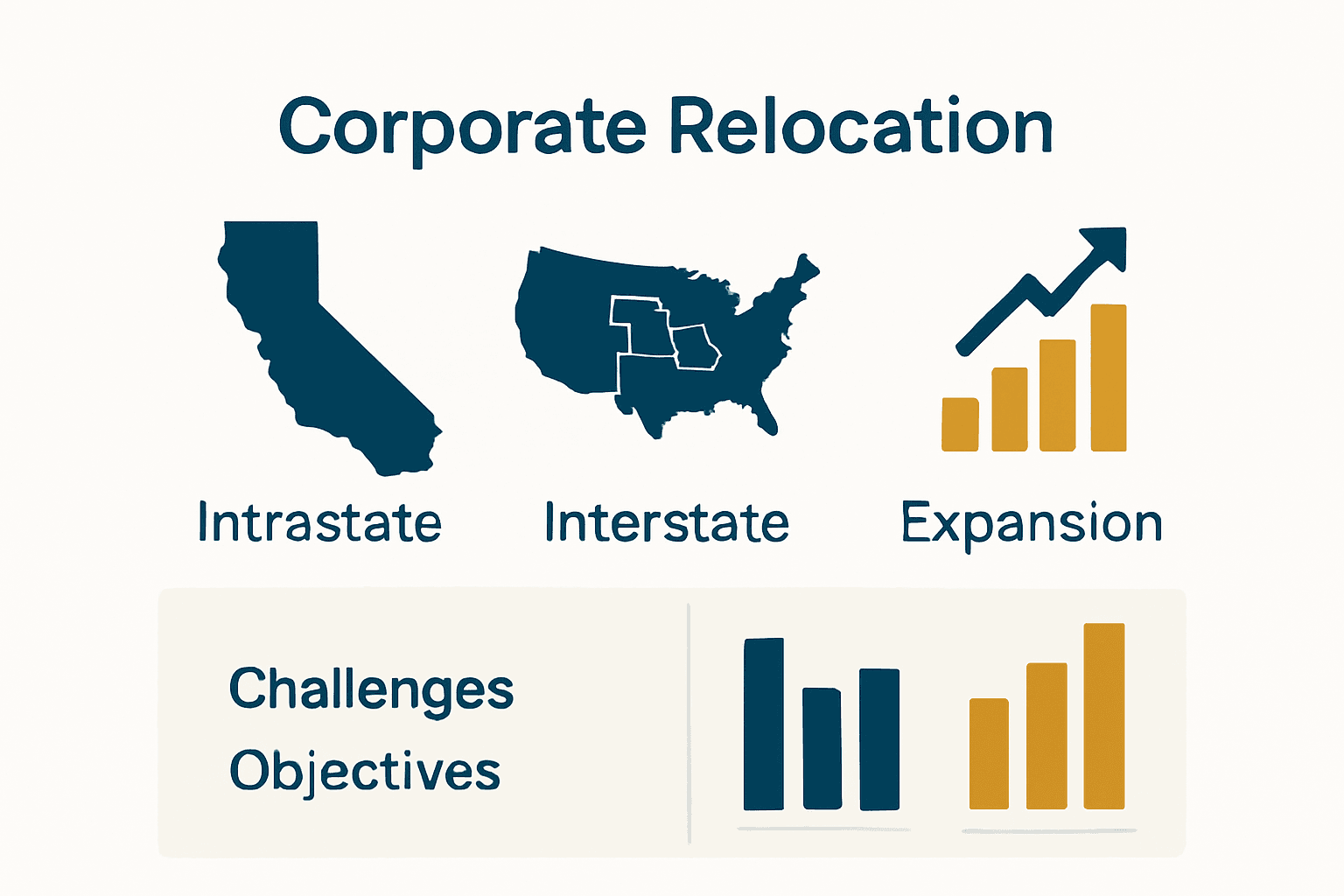
Corporate relocations represent complex strategic movements that go far beyond simple geographic transitions. These moves encompass various sophisticated types, each with unique challenges, objectives, and organizational implications that require careful planning and execution.
According to Economic Development, relocations can fundamentally be classified into three primary categories:
Beyond these geographic classifications, corporate relocations can be further categorized based on organizational objectives:
The Bureau of Labor Statistics highlights the complexity of workplace transitions, emphasizing that each relocation type represents a nuanced strategic decision involving multiple stakeholders and intricate logistical considerations.
Here’s a summary comparing the main types of corporate relocations and their key characteristics:
| Relocation Type | Geographic Scope | Primary Challenges | Key Objectives |
|---|---|---|---|
| Intrastate | Within same state | Local regulations Minimal logistics |
Cost-saving Quick transitions |
| Interstate | Between states | Legal compliance Complex logistics |
Business expansion Access new markets |
| Expansion | Any | Growth planning Space assessment |
Support company growth |
| Consolidation | Any | Site integration Resource allocation |
Improve efficiency Reduce costs |
| Cost-Optimization | Any | Budget constraints Vendor selection |
Reduce expenses |
| Talent Acquisition | Any | Talent assessment Cultural integration |
Attract skilled employees |
Successful corporate relocations require comprehensive understanding of relocation project management to navigate the multifaceted challenges inherent in these complex organizational shifts.
 Professional moving services play a critical role in transforming these potentially disruptive transitions into smooth, strategic opportunities for organizational evolution.
Planning and executing a corporate move is a multifaceted process that demands meticulous preparation, strategic coordination, and comprehensive risk management. Successful corporate relocations require a holistic approach that integrates logistical planning, employee communication, financial budgeting, and operational continuity strategies.
According to Procurement, organizations must carefully follow specific steps when managing moving expenses and working with contracted suppliers. These steps typically involve:
The HHS emphasizes the critical importance of “expert guidance and comprehensive labor solutions” when managing complex relocations involving personal property, office equipment, and organizational assets.
Key strategic considerations for corporate moves include:
Companies seeking a structured approach can leverage our office relocation guide for California to navigate the intricate process of corporate relocation with confidence and strategic precision. Professional moving services can transform what might seem like a complex logistical challenge into a smooth, strategically executed organizational transition.

Corporate relocations involve a complex web of legal, regulatory, and security challenges that require sophisticated strategic planning and meticulous attention to detail. Organizations must navigate a multifaceted landscape of compliance requirements, protecting both organizational assets and employee interests throughout the moving process.
According to the GSA, the Uniform Act provides critical protections for individuals and organizations during property acquisition, rehabilitation, or relocation projects. This legislative framework ensures that businesses and employees are treated fairly and receive appropriate assistance during significant organizational transitions.
Key legal and regulatory considerations include:
The GSA’s Employee Relocation Resource Center has developed sophisticated procurement tools and flexible programs that incorporate industry best practices and specialized expertise. These resources help organizations develop comprehensive relocation strategies that balance legal compliance with operational efficiency.
Given the intricate nature of corporate relocations, businesses must adopt a proactive approach to secure document transport and comprehensive risk management. Professional moving services can provide essential guidance in navigating these complex legal and regulatory landscapes, transforming potential challenges into strategic opportunities for organizational growth and seamless transition.
Corporate relocations represent significant financial investments that demand strategic financial planning, precise budgeting, and sophisticated operational management. Understanding the comprehensive financial landscape of corporate moves is crucial for organizations seeking to minimize economic disruption and maximize operational continuity.
According to Move.org, corporate relocation expenses can be substantial, with average costs ranging dramatically:
These significant financial considerations underscore the importance of developing a comprehensive budgeting strategy that accounts for both direct and indirect moving expenses.
Key strategies for managing corporate moving costs and minimizing business downtime include:
Importantly, Move.org also highlights that most employer-paid moves are considered taxable income by the IRS and local authorities, adding another layer of financial complexity to corporate relocations.
Businesses can effectively manage these challenges by developing robust contingency plans and partnering with professional moving services that specialize in minimizing operational disruptions. By adopting a strategic, proactive approach to corporate relocation, organizations can transform what could be a potentially disruptive process into an opportunity for streamlined operational enhancement.
Corporate relocations represent complex logistical challenges where seemingly minor oversights can lead to significant operational disruptions, financial losses, and employee dissatisfaction. Recognizing and proactively addressing potential pitfalls is crucial for ensuring a smooth, efficient organizational transition.
SIG Research demonstrates that even sophisticated tech companies with extensive relocation experience can encounter challenges, highlighting the universal nature of moving-related risks. By comparing relocation programs across 12 tech companies, researchers uncovered critical insights into common strategic missteps.
Most frequent corporate moving mistakes include:
According to SIG Research, benchmarking relocation policies at the highest level reveals that successful moves require nuanced, equitable approaches that balance organizational efficiency with individual employee needs.
Businesses can mitigate these risks by reviewing common moving mistakes and their solutions, developing robust contingency plans, and maintaining flexible, empathetic strategies that prioritize both operational continuity and human experience during complex organizational transitions.
Corporate moving can feel overwhelming with all the details you must manage such as employee communication, asset transfer, and legal compliance. The pain points mentioned in the guide like minimizing business downtime and avoiding common relocation mistakes are real challenges that can cost time and money if you do not have the right team behind you. When every step matters from planning your budget to executing a seamless technology migration, professional support is essential.
Discover how US Pro Logistics takes the stress out of complex corporate relocations by offering tailored moving solutions for businesses of every size. Whether you are planning an intrastate move or a multi-state expansion, our family-owned company delivers reliable and transparent service designed to protect your operations and employees. Visit our corporate moving resources and learn about our comprehensive services to help you navigate every phase with confidence. Don’t let your move disrupt your growth goals. Contact us today at usprologistics.org to request a quote and take the first step towards a smooth, efficient corporate relocation that supports your company’s future.
Corporate moving typically includes physical asset transfer, personnel management, infrastructure reconfiguration, and compliance with legal documentation requirements.
Businesses can minimize downtime by developing phased relocation plans, ensuring seamless technology transitions, and maintaining operational capabilities throughout the physical move.
Common mistakes include inadequate planning timelines, poor communication with employees, insufficient budget contingencies, and neglecting technology migration protocols.
Employee communication is critical during a corporate relocation as it helps maintain transparency, supports the workforce through transition, and minimizes disruptions to productivity.
USDOT 3664256 This number is required for any company that operates commercial vehicles in interstate commerce (across state lines). It helps identify and track the safety performance and compliance of transportation companies.
MC 1268070 This number is specifically for companies involved in the transportation of goods or passengers for hire across state lines. It’s necessary for carriers operating in the moving industry and ensures they are authorized to operate as interstate carriers.

