
Temporary storage is everywhere right now, showing up in moves, remodels, and even business projects. One number jumps out quickly—government guidelines often cap temporary storage at 90 days for most transitions. That sounds short, right? Most people expect to stash things away for far longer. The real surprise is how these quick setups end up solving problems even the biggest storage facilities cannot touch.
| Takeaway | Explanation |
|---|---|
| Evaluate security features | Choose storage options with surveillance, access controls, and on-site staff for maximum safety. |
| Consider climate control | Ensure sensitive items are protected from temperature and humidity fluctuations while stored. |
| Assess accessibility | Select storage locations that are convenient for easy access to your belongings. |
| Understand pricing structures | Analyze costs and any potential fees to avoid unexpected expenses. |
| Leverage storage during transitions | Use temporary storage to simplify moves, renovations, or other logistical challenges. |
Temporary storage options represent flexible solutions for individuals and businesses needing secure short-term space to store belongings during transitional periods like relocations, renovations, or between moves. These services provide a critical bridge during times of change, offering secure and adaptable storage solutions that protect personal and professional assets.
Below is a comparison table summarizing the different types of temporary storage options described in the article to help readers quickly understand their features and use cases.
| Storage Type | Description | Typical Features | Best For |
|---|---|---|---|
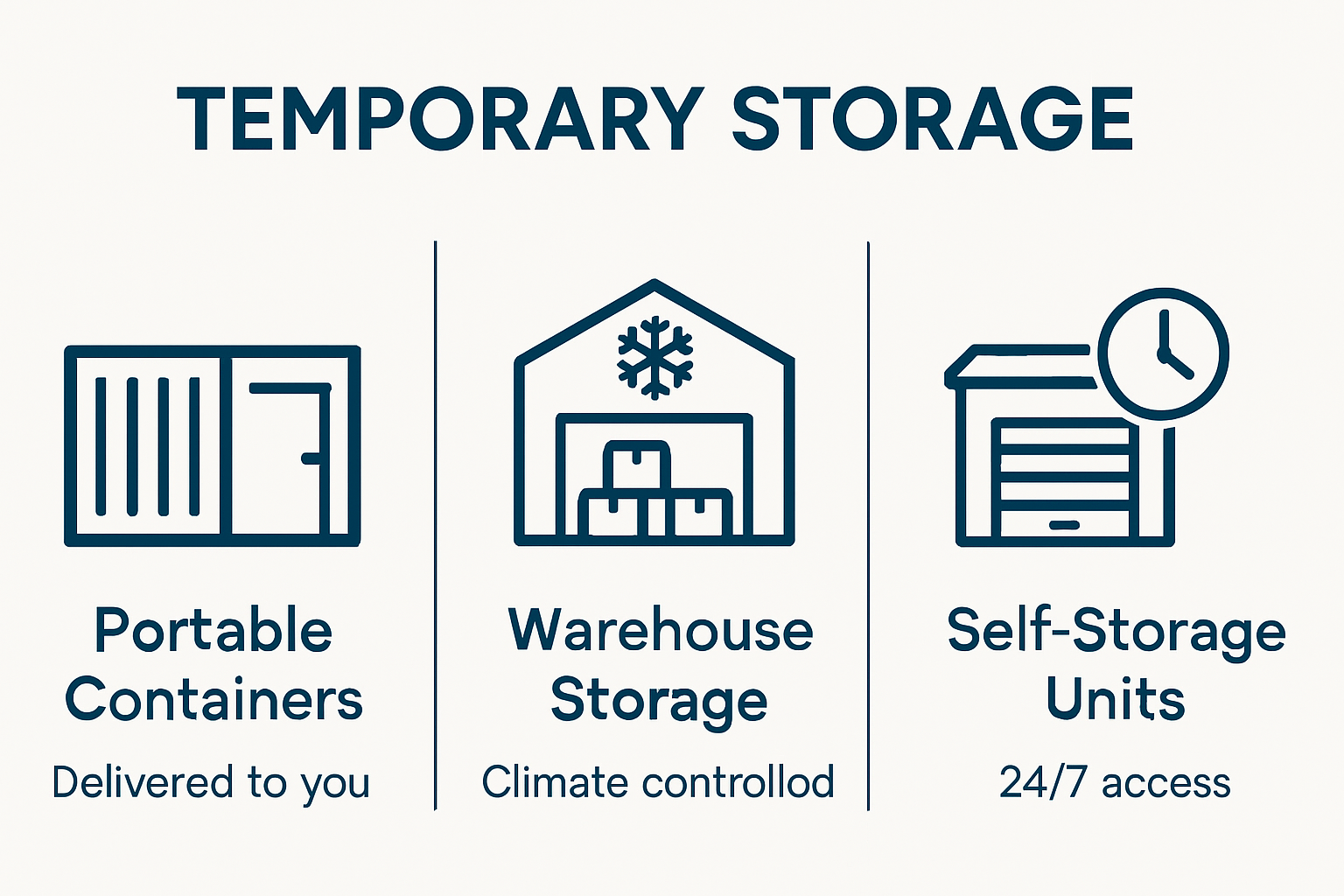
| Portable Storage Containers | Storage units delivered to your location for self-packing | On-site convenience, flexible timing | DIY movers, flexible packing schedules |
| Warehouse Storage | Professionally managed, climate-controlled facility storage | High security, climate control, professional staff | Sensitive items, business storage |
| Self-Storage Units | Rented spaces in various sizes with customer-controlled access | Direct access, range of sizes, flexible contracts | Ongoing access, varied household/business |
Temporary storage facilities come in multiple configurations designed to meet diverse needs. Portable storage containers offer convenient options where storage units are delivered directly to your location, allowing you to pack at your own pace. Warehouse storage provides professionally managed spaces with climate-controlled environments and enhanced security protocols. Self-storage units enable direct access and flexibility, typically available in various sizes to accommodate different storage requirements.
According to Cornell Law’s federal guidelines, temporary storage is often authorized for up to 90 days for government employees during relocation, establishing a standard duration benchmark for many storage services.
Selecting appropriate temporary storage involves evaluating several critical factors:
Temporary storage options provide more than just space they offer peace of mind during complex transitional periods. By understanding the available choices and evaluating specific needs, individuals and businesses can select storage solutions that provide optimal protection, accessibility, and value for their unique circumstances.
Temporary storage plays a pivotal role in simplifying complex moving processes, offering individuals and businesses strategic solutions during transitional periods. By providing flexible space management, temporary storage transforms potentially stressful relocations into seamless, organized experiences.
Moving involves intricate logistical challenges that temporary storage effectively addresses. When homes are sold, new residences are not immediately available, or renovation projects create displacement, temporary storage becomes an essential lifeline. Professional storage solutions bridge timing gaps, ensuring personal and professional belongings remain secure during uncertain transition periods.
According to Stanford University’s Property Management Manual, proper storage during relocations is crucial to prevent loss, damage, destruction, or theft of valuable assets.
Temporary storage offers multiple advantages that extend beyond simple space preservation:
By understanding and leveraging temporary storage options, individuals and businesses can transform potentially chaotic moving experiences into well-orchestrated transitions. Learn more about our comprehensive moving solutions that make relocation manageable and stress-free.
Temporary storage solutions function as sophisticated logistical systems designed to provide secure, flexible, and convenient space management for individuals and businesses during transitional periods. These comprehensive services integrate multiple components to ensure the safe preservation of personal and professional belongings.
Temporary storage solutions operate through a systematic approach that begins with client assessment and ends with secure item retrieval. Professional storage facilities utilize advanced infrastructure including climate-controlled environments, robust security systems, and specialized handling protocols. These facilities are engineered to protect diverse items ranging from household furniture to sensitive business equipment, maintaining optimal conditions throughout the storage duration.
According to the U.S. Forest Service’s Move Handbook, staging or temporary storage plays a critical role in managing complex moving scenarios, particularly when transition periods involve multiple logistical steps.
Effective temporary storage solutions incorporate several essential elements to guarantee comprehensive protection and accessibility:
Explore our comprehensive moving resources to understand how professional storage solutions can simplify your relocation experience. By leveraging these sophisticated systems, clients can transform potentially complex moving challenges into streamlined, stress-free transitions.
Selecting the right temporary storage solution requires careful evaluation of multiple factors to ensure the safety, accessibility, and cost-effectiveness of storing personal or professional belongings. The decision involves more than simply finding available space it demands a strategic approach that addresses specific storage needs and potential challenges.
Effective storage selection begins with a comprehensive assessment of your specific needs. This involves carefully analyzing the types of items to be stored, their sensitivity to environmental conditions, and the anticipated storage duration. Different items require different storage environments some demand climate-controlled spaces, while others might need specialized security measures. Understanding the unique characteristics of your belongings helps determine the most appropriate storage solution.
According to research on storage best practices, choosing an appropriately sized storage unit prevents potential damage from overcrowding and avoids unnecessary expenses from underutilization.
When selecting a temporary storage solution, several key factors demand careful consideration:
Discover more about our storage solutions to understand how professional storage services can meet your unique requirements. By systematically evaluating these critical considerations, individuals and businesses can make informed decisions that ensure the optimal protection and management of their valuable assets during transitional periods.
Temporary storage solutions extend far beyond simple personal moving needs, serving critical functions across various industries and scenarios. These versatile services provide strategic solutions for managing assets, supporting complex logistical challenges, and maintaining operational continuity during transitions.
Temporary storage plays a pivotal role in diverse professional environments, addressing unique challenges across different sectors. Businesses utilize these solutions during office renovations, equipment upgrades, or corporate relocations. Universities employ temporary storage during campus construction projects, libraries manage collection transitions, and government agencies utilize secure storage during facility modifications.
According to research examining library collection relocations, strategic temporary storage is essential for maintaining service continuity during complex institutional transitions.
Temporary storage solutions serve multiple real-world applications across different contexts:
Learn more about our specialized storage solutions that can be tailored to meet unique organizational needs. By understanding the extensive applications of temporary storage, businesses and institutions can develop more resilient, flexible operational strategies that minimize disruption and maximize efficiency during complex transitional periods.
The following table highlights key real-world scenarios where temporary storage offers strategic benefits across industries and unique use cases, making the options discussed more concrete for the reader.
| Scenario | Purpose of Temporary Storage |
|---|---|
| Office Renovation | Store equipment/furniture during workspace upgrades |
| Academic Institution Construction | Manage collections and materials during campus projects |
| Disaster Response | Pre-position emergency supplies or relief materials |
| Construction Projects | Safeguard sensitive equipment and building materials |
| Healthcare Facility Upgrades | Secure medical equipment and supplies during remodeling |

When dealing with the stress of moving, the uncertainty of where to safely keep your belongings can feel overwhelming. The article highlighted key challenges like managing timing gaps during a move, protecting your assets during temporary transitions, and finding reliable, climate-controlled storage solutions. If you are worried about sensitive items or complex moving timelines, you are not alone. Many face these same pressures when navigating local, long-distance, or specialized relocations.
Let US Pro Logistics help you turn moving stress into peace of mind. We offer professional secure storage services that are trusted by families, businesses, and government clients across California and nationwide. From climate control to advanced security and flexible access, your belongings will be protected just as you expect. Experience why so many choose our personalized moving solutions for a safe, smooth transition. Visit US Pro Logistics now to request your free quote and find the right storage fit before your move date books up.
Temporary storage options include portable storage containers, warehouse storage, and self-storage units, each offering different configurations and access levels to meet diverse needs.
Temporary storage is often authorized for up to 90 days for government employees, which serves as a common duration benchmark for many temporary storage services during relocation.
When selecting temporary storage, consider security measures, climate control options, insurance coverage, accessibility, and costs to ensure your belongings are well-protected and conveniently stored.
Using temporary storage can provide flexibility in moving timelines, protect valuable assets, reduce moving day stress, serve as a cost-effective alternative, and enhance logistical planning for complex moves.
USDOT 3664256 This number is required for any company that operates commercial vehicles in interstate commerce (across state lines). It helps identify and track the safety performance and compliance of transportation companies.
MC 1268070 This number is specifically for companies involved in the transportation of goods or passengers for hire across state lines. It’s necessary for carriers operating in the moving industry and ensures they are authorized to operate as interstate carriers.

