Moving a piano is more than just hauling furniture across a room. Think about this. An upright piano can weigh between 300 to 900 pounds, while a grand can easily exceed 1,200 pounds. Most people imagine strength is enough for the job but professional movers know success depends on smart planning, specialized tools, and the kind of careful assessment most folks skip. What surprises many is that a moment’s oversight can hurt your instrument far more than a lack of muscle ever could.
| Key Point | Explanation |
|---|---|
| 1. Assess the piano’s size and type | Measure dimensions and identify if it’s an upright, grand, or specialty piano to strategize the move effectively. |
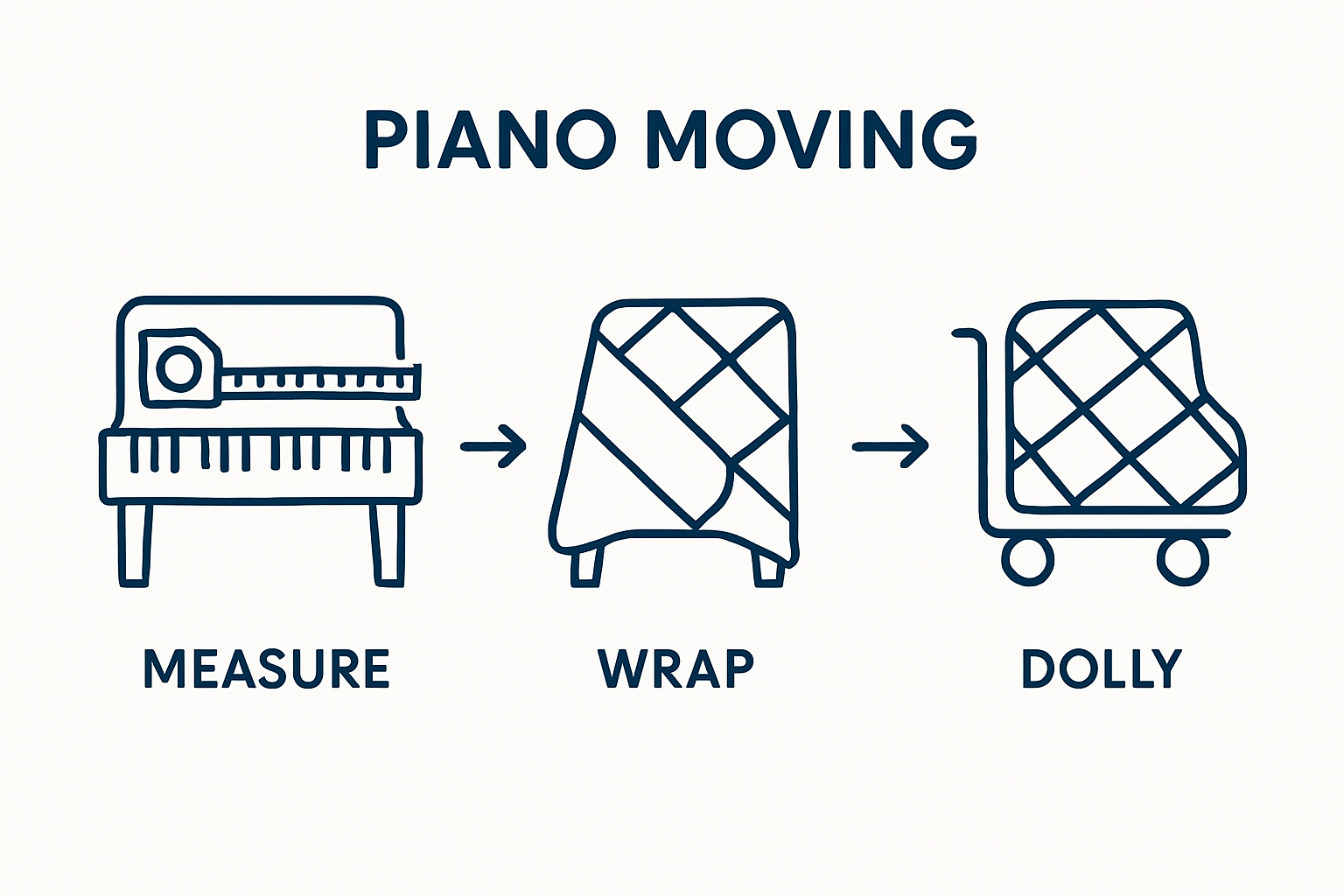
| 2. Gather specialized moving tools | Use moving blankets, straps, dollies, and protective gear to ensure safe transport and prevent damage during the move. |
| 3. Prepare the moving path thoroughly | Clear obstacles and protect floors to create a safe, unobstructed route for moving the piano with ease. |
| 4. Secure the piano properly for transport | Wrap the piano carefully to immobilize it and protect against damage during movement with blankets and straps. |
| 5. Check the piano post-move | Inspect for damage and ensure it’s level and functioning before settling it into its new location. |
Moving a piano is not just about lifting and transporting a musical instrument - it’s about carefully handling a delicate, complex piece of equipment that requires precise planning and expertise. Your first critical task in how to move a piano safely involves thoroughly understanding the specific type and dimensions of your instrument.
Piano Categories and Their Moving Complexity
Pianos generally fall into three primary categories: upright pianos, grand pianos, and specialty pianos. Each category presents unique challenges that dramatically impact your moving strategy. Upright pianos, typically standing 3 to 5 feet tall, are more compact and slightly easier to maneuver. Grand pianos, with their horizontal design and longer body, require significantly more specialized handling and often need partial disassembly.
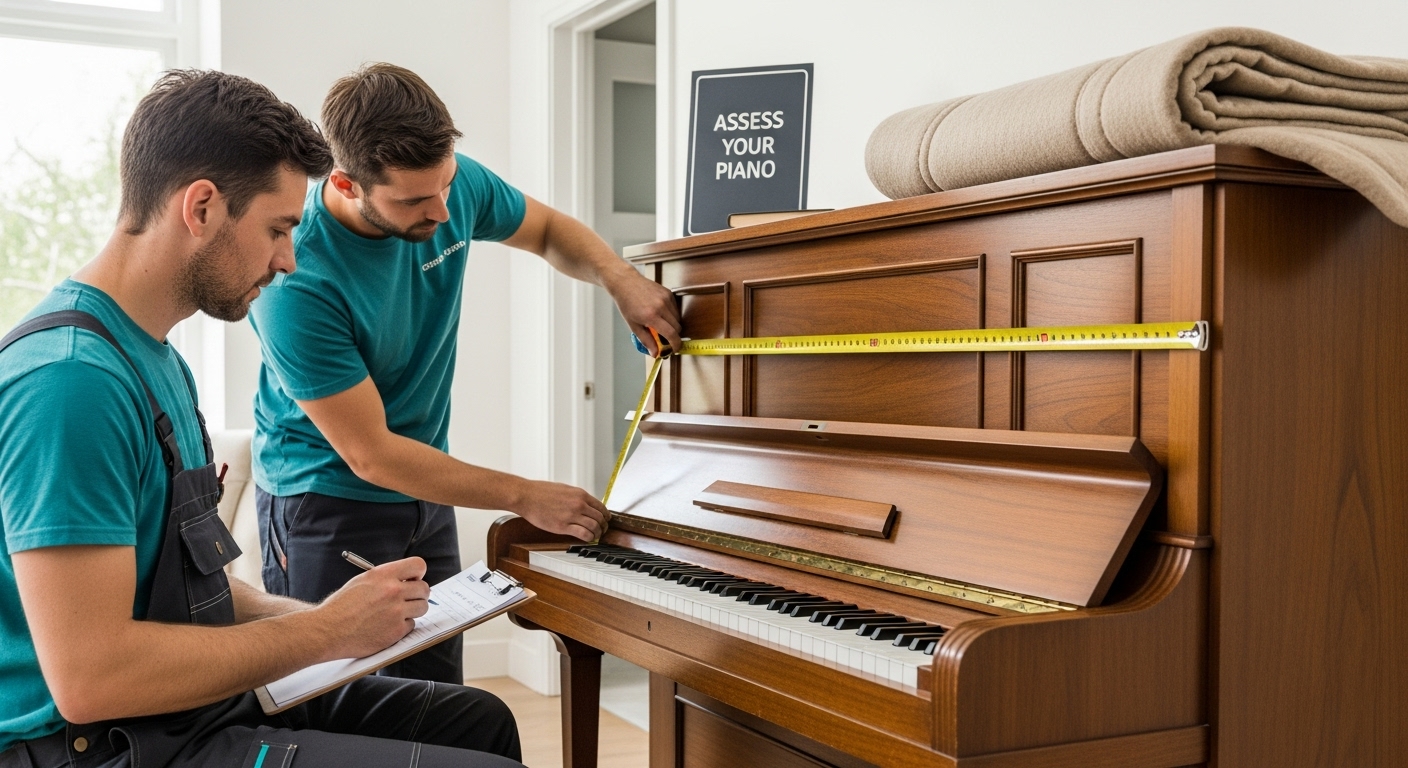
Carefully measure your piano’s exact dimensions before planning any move. For upright pianos, measure height, width, and depth while standing vertically. For grand pianos, measure length from tail to keyboard and width across the body. Precise measurements are crucial for determining the right equipment, number of movers needed, and potential moving challenges like narrow doorways or tight staircases.
Specialty pianos such as antique models or high-end concert instruments demand even more meticulous assessment. These unique instruments might require custom crating, climate-controlled transportation, and expert handlers with specific training in rare instrument relocation.
Consider these verification steps to confirm you’ve completed a thorough assessment:
By investing time in this initial assessment, you’ll set the foundation for a safe, successful piano move that protects your valuable instrument from potential damage.
Successful piano moving requires more than muscle strength - it demands strategic preparation and specialized equipment. Think of this stage as assembling a precise toolkit that will protect your valuable instrument throughout its complex journey. Professional movers understand that proper equipment is your first line of defense against potential damage.
Your moving arsenal should include heavy-duty moving blankets, which provide critical padding and shock absorption during transportation. Professional-grade moving straps are essential for secure lifting and controlled movement, distributing weight evenly across multiple carriers. Furniture dollies with robust rubber wheels become crucial for grand and upright pianos, allowing smooth, controlled movement across different floor surfaces.
Protective gear is equally important for the movers themselves. Thick moving gloves provide grip and hand protection, while back support belts help prevent strain during the challenging lifting process. Furniture sliders can help position the piano without causing floor scratches, and robust moving tape will secure protective coverings firmly in place.
Prepare a dedicated moving kit that includes these critical items:
Before beginning the move, verify your equipment’s condition. Check moving blankets for tears, ensure straps can support significant weight, and confirm dolly wheels rotate smoothly. By meticulously preparing your tools, you transform a potentially risky move into a controlled, professional operation. Each piece of equipment represents an investment in your piano’s safe transportation.
Here is a concise table summarizing essential tools and supplies for moving a piano, along with their purpose so you can efficiently assemble your moving kit.
| Tool/Supply | Purpose |
|---|---|
| Heavy-duty moving blankets | Protects piano from scratches and shocks |
| Professional moving straps | Secures lifting and provides controlled handling |
| Furniture dolly | Aids in moving the heavy weight smoothly |
| Protective moving gloves | Improves grip and hand safety |
| Back support belt | Reduces risk of back strain |
| Furniture sliders | Assists in positioning without floor damage |
| Strong packing tape | Secures protective blankets and coverings |
| Measuring tape | Accurately measures piano and moving paths |
| Screwdriver set | Used for minor disassembly if necessary |
Preparing your moving path is a critical precision operation that can make the difference between a smooth piano relocation and a potential disaster. Environmental preparation is not just about clearing space - it’s about creating a strategic, safe corridor for moving your delicate instrument.
Begin by conducting a comprehensive survey of your entire moving route. Walk the path slowly, identifying and removing potential obstacles like area rugs, side tables, decorative items, and loose floor mats. Pay special attention to doorways, hallways, and staircases - these are typically the most challenging sections of any piano move. Measure doorway and hallway widths to ensure your piano can pass through without requiring disassembly.
Protect your floors by laying down heavy-duty moving blankets or specialized floor runners. Hardwood, tile, and carpeted surfaces all require different protection strategies. Secure these protective coverings using painter’s tape, which won’t leave residue or damage flooring surfaces. Temperature and humidity also play crucial roles in piano moving, so ensure your path maintains a consistent environment to prevent potential instrument damage.
Consider these critical path preparation steps:
Verify your preparation by walking the entire route multiple times, visualizing the piano’s movement. Imagine potential challenges and plan contingencies. A well-prepared path transforms a complex moving challenge into a controlled, systematic process, significantly reducing the risk of damage to your piano and surrounding environment.
Securing a piano for transport is a delicate art that requires precision, patience, and strategic planning. The goal is to immobilize the instrument completely, preventing any potential movement that could cause internal or external damage during transportation. This step transforms your piano from a fragile musical instrument into a carefully protected cargo ready for safe relocation.
Begin by closing and locking the piano lid to prevent it from accidentally opening during movement. For grand pianos, use specialized piano lid straps that keep the lid securely shut. Wrap the entire instrument in thick moving blankets, ensuring complete coverage from top to bottom. Pay special attention to corners and protruding parts like pedals and legs, using additional padding to create a protective buffer.
Professional movers recommend using shrink wrap or moving tape to secure the protective blankets, creating a tight, immobile covering that prevents shifting. For upright pianos, wrap vertically, ensuring the blankets extend from top to bottom. Grand pianos require a more complex wrapping technique, often involving partial disassembly of legs and careful padding of the delicate body.
Verify your piano’s transport readiness with these critical checks:
The final step involves carefully positioning the wrapped piano onto the furniture dolly. Move slowly and deliberately, maintaining constant communication with your moving partners. Remember that a moment of carelessness can result in significant damage to an instrument that may be both financially and emotionally valuable. Treat each movement as if you are handling a precious, irreplaceable piece of art.
Executing a piano move is a synchronized dance of precision, strength, and strategic communication. Professional movers understand that this is not a solo performance but a carefully choreographed team effort where every movement must be calculated and controlled. The moment of actual transportation represents the culmination of all your previous preparation.
Begin by establishing clear communication protocols among your moving team. Designate a lead coordinator who will provide verbal commands and ensure everyone understands their specific role. For grand pianos, this typically involves at least four strong individuals positioned at strategic points - two at the body, one at the keyboard end, and one managing the dolly. Upright pianos require a minimum of three movers, maintaining a balanced, controlled lift.
Lifting technique is critical to preventing both personal injury and potential piano damage. Always lift using legs, not backs, keeping the piano close to your body’s center of gravity. Move in synchronized, slow steps, maintaining a steady, level position. Avoid sudden movements, turns, or jerking motions that could destabilize the instrument or cause strain to the movers.
Consider these critical execution guidelines:
As you navigate doorways, stairs, and tight spaces, move with extreme caution. Each transition point represents a potential risk zone where careful planning and precise coordination become paramount. Watch for uneven surfaces, adjust your grip, and move as a unified team, treating the piano as a delicate, irreplaceable piece of musical craftsmanship.
The final stage of piano moving is a critical moment of precision and careful assessment. Your objective is to transform transportation success into long-term instrument preservation. This isn’t merely about placing the piano in its new location, but ensuring its structural integrity, acoustic quality, and future performance remain uncompromised.
Begin by slowly removing the protective wrapping, paying close attention to any potential signs of damage or stress. Inspect the piano’s exterior carefully, checking for scratches, dents, or alignment issues that might have occurred during transportation. For grand pianos, verify that legs are securely reattached and level. Upright pianos should be checked for any internal mechanism shifts or external structural changes.
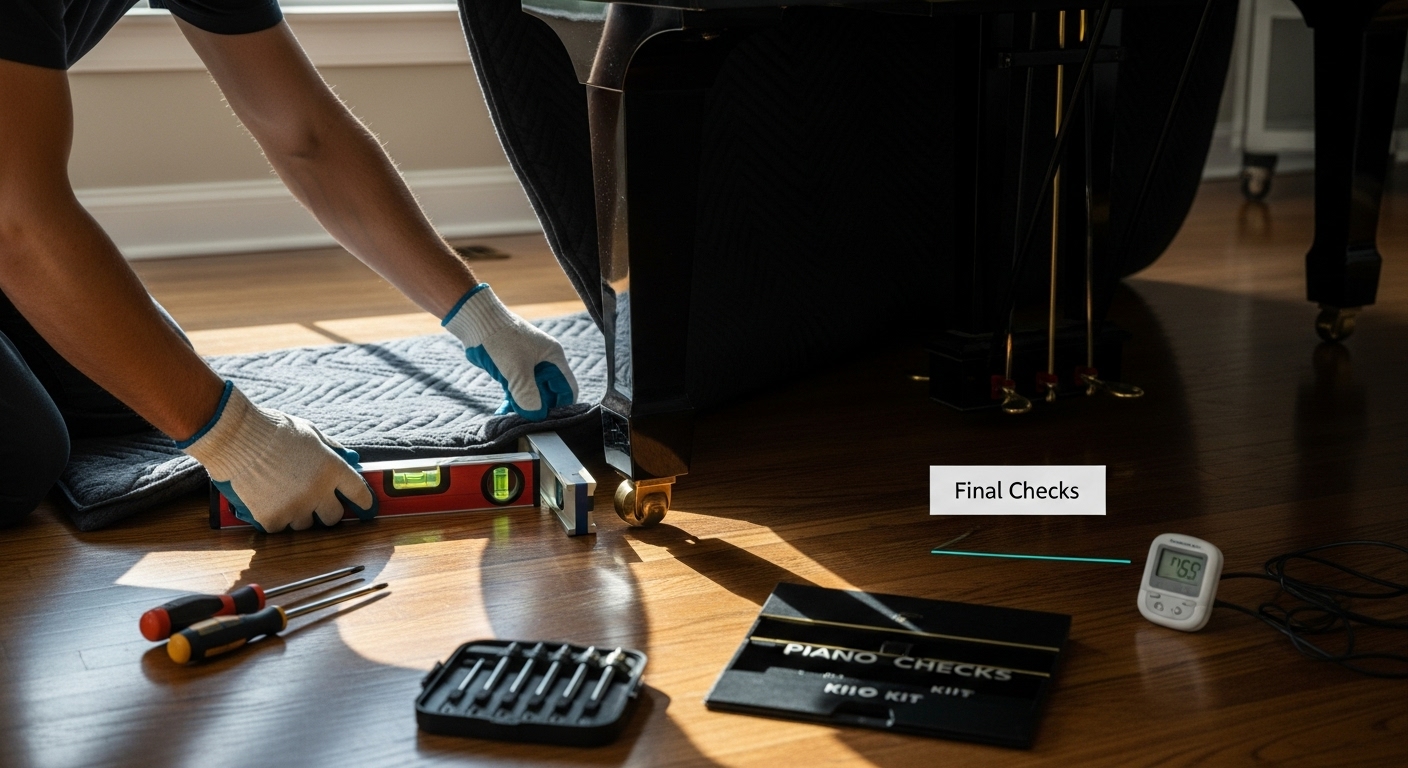
Position the piano precisely in its designated location, ensuring it sits on a level surface away from direct sunlight, heating vents, and air conditioning units. Temperature and humidity are critical factors in maintaining your instrument’s long-term health. Use a small level to confirm the piano sits perfectly horizontal, making minute adjustments to prevent internal stress on the frame and soundboard.
Verify your piano’s post-move condition with these essential checks:
Consider scheduling a professional tuning within two weeks of moving. Transportation can subtly impact string tension and internal mechanics, and a skilled technician can make precise adjustments that preserve your instrument’s sound quality. Treat this final verification as more than a checklist - it’s your commitment to protecting a potentially irreplaceable musical companion that carries both monetary and emotional value.
This checklist table provides key post-move verification steps, making it easy to confirm your piano is safe and ready for use after relocating.
| Post-Move Check | What to Do |
|---|---|
| Inspect exterior for damage | Check for scratches, dents, or alignment issues |
| Confirm piano is level | Use a small level to ensure proper horizontal placement |
| Test moving parts | Make sure all mechanisms and pedals function smoothly |
| Check for internal misalignment | Look for shifted mechanisms, especially after transport |
| Listen for unusual sounds | Press keys and listen for any odd noises |
| Schedule professional tuning | Book a technician to restore acoustic quality |
When it comes to moving a piano, the true challenge is not just the weight or size. It is about safeguarding a valuable instrument, preserving your peace of mind, and ensuring that every delicate detail is handled with care. If you have spent hours learning how to secure your piano, gather the right tools, and plan a safe path, you already know that a small mistake can mean costly repairs or lost memories. Why take that risk alone, especially when expert precision and emotional reassurance are only a step away?

Let the team at US Pro Logistics turn your careful planning into a flawless move. Our expert movers specialize in piano transportation and personalized relocation, serving both California and clients across the United States. We handle everything from custom equipment and protective wrapping to safe delivery and instrument inspection. You deserve a service that values your investment as much as you do. Visit US Pro Logistics now to request a quote or connect with our support team. For immediate answers about our process, check out our trust-building FAQ section. Move your piano safely, confidently, and without worry today.
Pianos are generally classified into upright pianos, grand pianos, and specialty pianos. Each type presents unique challenges due to size, weight, and design, impacting your moving strategy and potential equipment needs.
To properly secure a piano for transport, close and lock the lid, wrap the instrument completely in heavy-duty moving blankets, and use shrink wrap or packing tape to immobilize the padding while protecting corners and protruding components.
Essential tools include heavy-duty moving blankets, professional moving straps, a furniture dolly, protective gloves, back support belts, furniture sliders, strong packing tape, and a measuring tape to ensure safe handling during the move.
To prepare your moving path, remove obstacles, measure doorframes and hallways, protect floors with heavy-duty blankets or runners, and ensure good lighting along the route. A clear, unobstructed path minimizes risks during the move.
USDOT 3664256 This number is required for any company that operates commercial vehicles in interstate commerce (across state lines). It helps identify and track the safety performance and compliance of transportation companies.
MC 1268070 This number is specifically for companies involved in the transportation of goods or passengers for hire across state lines. It’s necessary for carriers operating in the moving industry and ensures they are authorized to operate as interstate carriers.

