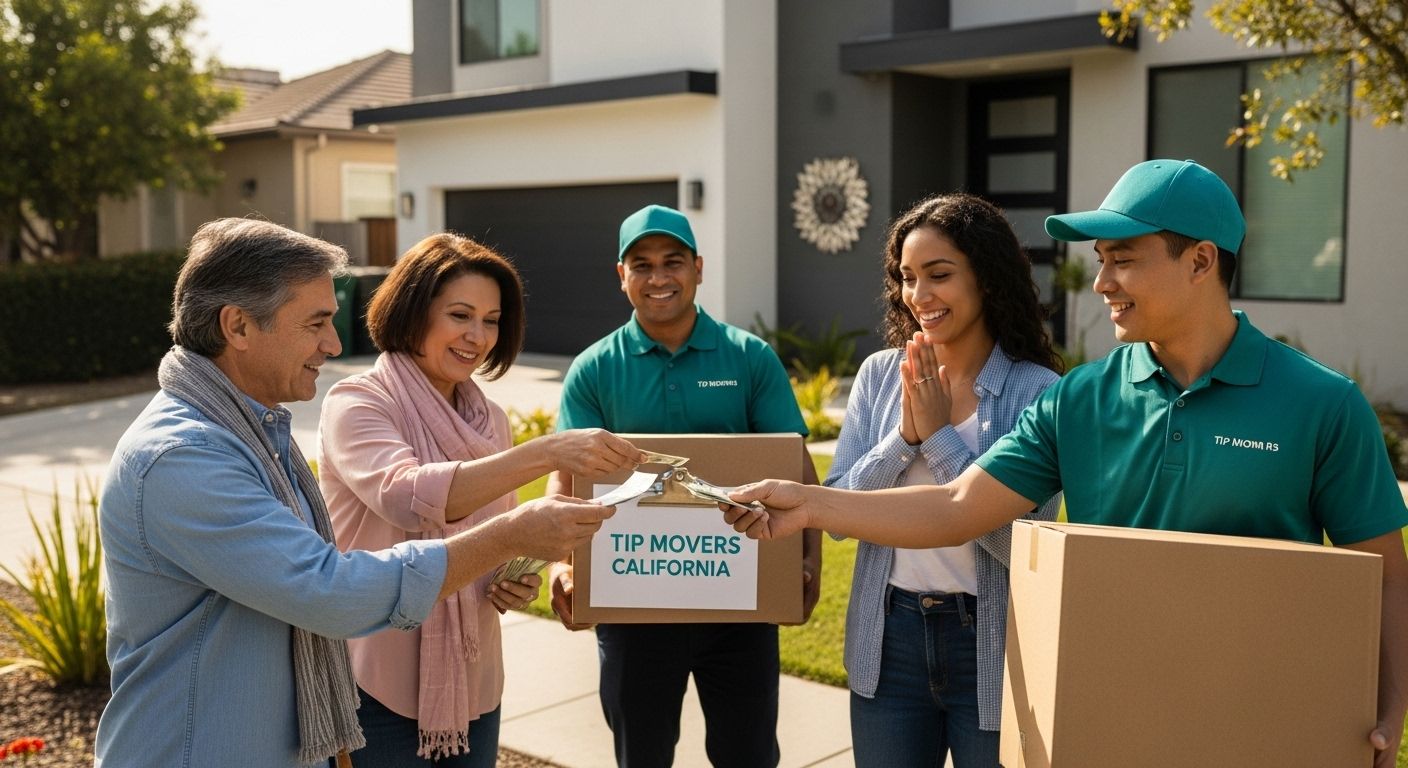
Figuring out how much to tip movers in California feels tricky for almost everyone. Some people think a flat rate works while others swear by a percentage model. Here is something most folks miss though. The standard advice is to tip $5 per hour per mover or about $40 to $60 for a full day, but unique situations often call for even more thoughtful gestures. If you want to make sure your movers feel genuinely appreciated, look beyond the basics and see what really makes a difference.
| Takeaway | Explanation |
|---|---|
| Tip $5 per hour per mover | Standard tipping etiquette suggests $5 for each hour of work per mover, adjusted for service quality. |
| Local moves: $20 to $60 per mover | For local moves, tip between $20 to $30 for half-day moves and $40 to $60 for full-day moves. |
| Long-distance: $50 to $100 per mover | For interstate moves, consider tipping $50 to $100 per mover depending on duration and complexity. |
| Show additional appreciation | Offer refreshments or snacks, ensure clean restroom access, and express verbal thanks to enhance morale. |
| Recognize exceptional service | If movers handle items with care or navigate challenges, consider increasing the tip accordingly. |
Tipping movers is more than just a financial transaction it’s a way to recognize the challenging physical labor and professional service that goes into relocating your belongings. While tipping is not mandatory, it is a widely accepted practice that shows appreciation for the hard work and care your moving team provides during what can be a stressful life event.
The process of tipping movers involves more than simply handing over cash. Learn more about professional moving services to understand the complexity of their work. According to research from Move.org, standard tipping guidelines suggest $5 per hour per mover, which can be adjusted based on the quality of service. For local moves, most experts recommend tipping between 15% to 20% of the total moving bill.
Factors that might influence your tipping decision include the complexity of the move, the number of items, the distance traveled, and the overall level of professionalism demonstrated by the moving team. Moves involving specialty items like pianos, antiques, or large furniture pieces might warrant a higher tip to acknowledge the extra skill and care required.
National Movers Association recommends specific tipping strategies based on different move scenarios. For a half-day move (approximately 4 hours), consider tipping $20 to $30 per mover. For a full-day move lasting 8 hours or more, the recommended tip increases to $40 to $60 per mover.
There are several recommended ways to tip movers:
Additional considerations for tipping include providing water or refreshments during the move, which can be a thoughtful gesture alongside monetary compensation. If movers go above and beyond by handling delicate items with exceptional care, navigating challenging spaces, or working efficiently under time constraints, consider increasing the tip.
Remember that tipping is a personal decision and should reflect your satisfaction with the service. While guidelines exist, the final amount depends on your assessment of the movers’ performance and the overall moving experience. Communicating directly with the moving team and expressing your appreciation can make the tipping process more meaningful for everyone involved.
Tipping movers varies significantly depending on the type, complexity, and duration of your move. Understanding these nuanced differences helps ensure you appropriately compensate professionals for their hard work and dedication.
Here’s a table summarizing recommended tip amounts for various types of moves, based on the duration and complexity described in the article:
| Move Type | Duration | Recommended Tip per Mover | Additional Considerations |
|---|---|---|---|
| Local Move (Half-Day) | ~4 hours | $20 - $30 | Adjust for stairs, heavy items, service level |
| Local Move (Full Day) | ~8 hours | $40 - $60 | Extra tip for difficult conditions |
| Long-Distance/Interstate | 1+ days | $50 - $100 | Tip varies by move complexity and duration |
| Specialty Items (e.g. piano, art) | Varies | Add $20 - $50 (to tip) | For high-value/challenging items |
| Military/Government Relocation | Varies | Standard or more generous | Consider strict timing/logistics |
| Senior/Special Care Move | Varies | Standard or more generous | Consider extra care/patience |
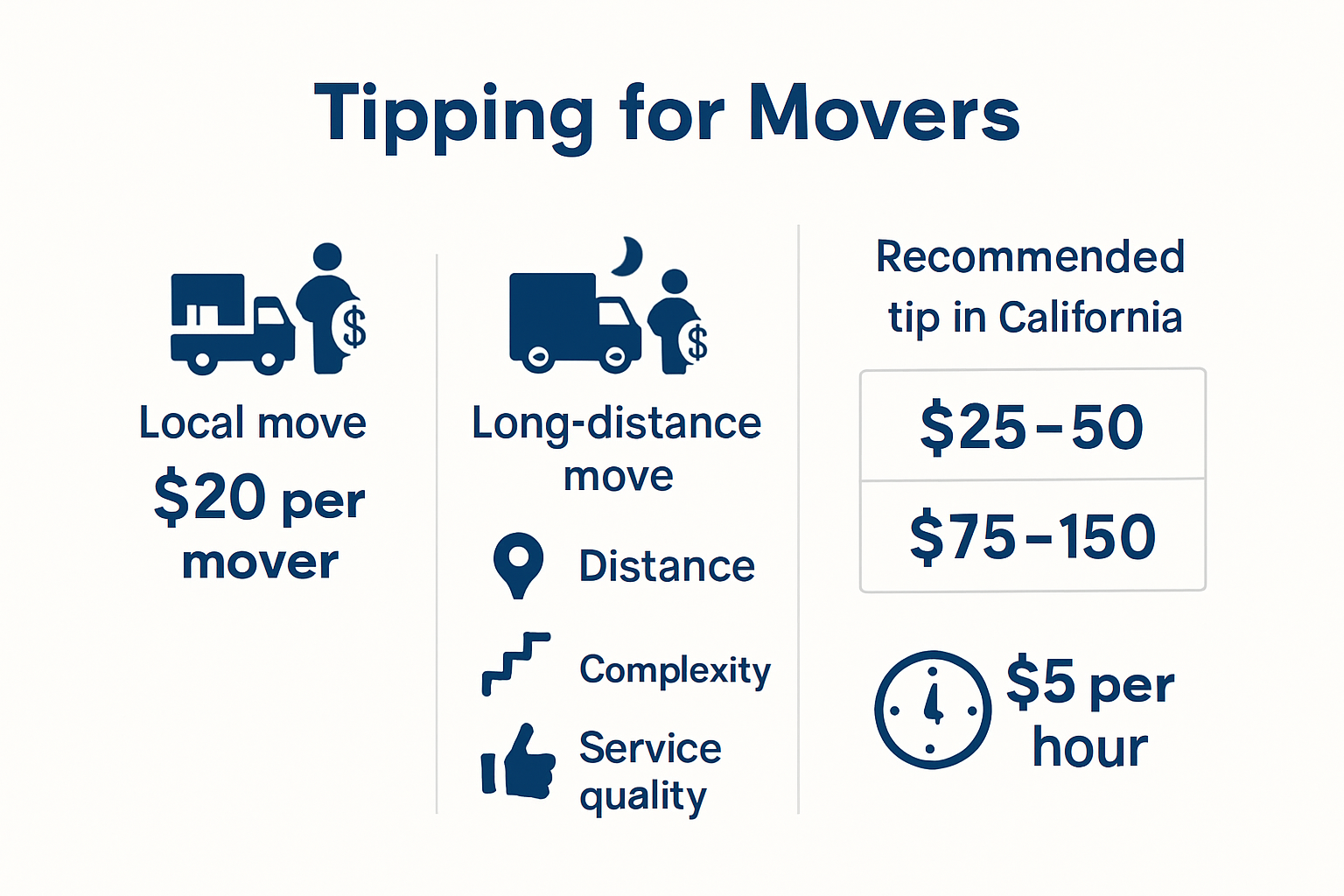
For local moves typically lasting 4 to 8 hours, explore our cross-country moving strategies to understand the intricacies of relocation. According to Move.org, standard tipping practices for local moves range from $10 to $50 per mover. For a half-day move (4 hours), consider tipping $20 to $30 per mover. Full-day moves (8 hours) might warrant $40 to $60 per mover.
Key factors influencing tip amounts include the number of items, difficulty of the move, stairs or long walking distances, and overall service quality. Moves involving narrow hallways, multiple floors, or heavy furniture may justify a higher tip due to increased physical effort.
Long-distance moves require different tipping considerations. California’s Department of Industrial Relations confirms that tips are the sole property of employees. For interstate moves, which often involve multiple days of work, experts recommend tipping $50 to $100 per mover, depending on the total move duration and complexity.
Specialty moves involving delicate items like pianos, antiques, or artwork might require additional compensation. Consider adding $20 to $50 to the total tip for crews handling exceptionally challenging items. Complex moves might include:
Some moving scenarios require nuanced tipping approaches. Apartment moves in dense urban areas might involve more challenging logistics. Commercial moves or office relocations often have different tipping expectations compared to residential moves.
Additional factors to consider include weather conditions, unexpected challenges during the move, and the overall professionalism of the moving crew. If movers demonstrate exceptional service by protecting floors, carefully wrapping furniture, or going above and beyond standard expectations, consider increasing the tip.

Remember that tipping is ultimately a personal decision reflecting your satisfaction with the service. While guidelines provide helpful frameworks, the final tip should reflect the specific circumstances of your move and the quality of service received. Always communicate directly with your moving team and express appreciation for their hard work.
Special relocations require unique considerations when it comes to tipping, as the complexity and challenges of these moves often go beyond standard residential or commercial moving services. Understanding the nuanced approaches to tipping in these specialized scenarios ensures fair compensation and appreciation for professional moving crews.
Explore our office relocation strategies to understand the intricacies of complex moves. Military and government relocations often involve additional logistical challenges that warrant special tipping considerations. According to the Federal Motor Carrier Safety Administration, these moves typically involve stringent regulations and precise coordination.
For military personnel and government employees, tipping practices might differ slightly from civilian moves. While standard tipping guidelines still apply, the complexity of these moves often justifies a more generous approach. Consider these factors:
Moves involving seniors or individuals with special needs require extra care and attention. The California Public Utilities Commission emphasizes the importance of understanding special moving requirements. Tipping for these moves should reflect the additional patience, care, and specialized skills required.
Specialized care moves might involve:
Relocations involving high-value or specialty items demand a unique approach to tipping. Moves with antiques, artwork, musical instruments, or expensive electronics require exceptional skill and precision. Consider increasing tips for crews demonstrating extraordinary care and expertise.
Key considerations for specialty item moves include:
Remember that tipping is ultimately a personal decision that should reflect the quality of service and the specific challenges of your move. While guidelines provide a helpful framework, the final tip should acknowledge the unique circumstances of your relocation. Communication and genuine appreciation remain the most important aspects of recognizing your moving team’s hard work.
Providing refreshments, offering words of thanks, and ensuring each team member receives individual recognition can be just as meaningful as the monetary tip. Always approach tipping as a way to show genuine appreciation for the skill, effort, and professionalism demonstrated during your special relocation.
While monetary tips are the most common way to recognize moving professionals, there are numerous meaningful alternatives to express genuine gratitude for their hard work and dedication. Learn about the benefits of professional moving services to understand the complexity of their work and why appreciation matters.
The following table highlights practical, non-monetary gestures to show appreciation to your moving team, organizing suggestions mentioned throughout the article:
| Gesture/Action | Purpose | When to Offer |
|---|---|---|
| Provide refreshments (water/snacks) | Keep movers hydrated and energized | During the move, especially in heat |
| Ensure restroom access | Maintain comfort and morale | Throughout the moving process |
| Create shaded break area | Support rest during breaks | If move lasts several hours |
| Write thank-you note | Personal recognition | At the end of the move |
| Give positive review/recommendation | Acknowledge service publicly | After the move is complete |
| Offer sunscreen/bug spray | Protect movers from elements | For outdoor or summer moves |
| Prepare pathways/clear space | Make work easier and safer | Before movers arrive |
According to Arizona State University’s Lodestar Center, meaningful appreciation goes beyond financial compensation. Practical gestures can significantly impact a moving crew’s experience and morale.
Consider these thoughtful ways to show appreciation:
The University of Missouri System emphasizes the importance of personalized recognition. A genuine, heartfelt approach can mean more than monetary compensation. Take time to:
Southern Illinois University School of Medicine suggests that acts of service can be powerful ways of showing appreciation. During challenging moves, consider these supportive actions:
Remember that moving is physically demanding work. Movers often handle heavy, delicate items while navigating complex spaces. Your recognition can make a significant difference in their day. Small acts of kindness demonstrate respect for their profession and the incredible effort they put into helping people transition to new homes and spaces.
Ultimately, authentic appreciation is about recognizing the human element behind the service. Whether through a cold drink on a hot day, a sincere thank-you, or helping to create a comfortable working environment, your gestures can transform a standard moving experience into a memorable, positive interaction.
The standard tipping guideline is approximately $5 per hour per mover, or between $40 to $60 for a full day of moving. However, you may consider increasing the tip based on the quality of service and complexity of the move.
When deciding how much to tip, consider the complexity of the move, distance traveled, number of items, any specialty items being moved, and the overall professionalism of the moving team.
Yes, tipping practices may vary. For local moves, a tip of $20 to $60 per mover is common, while for long-distance moves, consider tipping $50 to $100 per mover, depending on the move’s complexity and duration.
Absolutely! Providing refreshments, ensuring clean restroom access, offering words of thanks, and creating a comfortable break area can significantly boost morale and show appreciation for the movers’ hard work.
Worried about how to show appreciation when your move involves more than just boxes and heavy lifting? Finding the right way to tip movers is important, but choosing a moving company that values service from start to finish is even more critical. We understand that dealing with complex moves, wondering about proper etiquette, and hoping your belongings are handled with care can quickly become overwhelming. This is where the right moving partner makes all the difference. See how our team delivers not only on logistics but also on integrity, professionalism, and respect.
Let US Pro Logistics handle your next California move so you can focus on what matters most. Experience straight answers about tipping, detailed moving support for any situation, and a company that stands by its reputation. Check out our main site for full details on how we manage residential, commercial, and specialty moves. Ready to have one less thing to worry about on moving day? Visit US Pro Logistics and request your free personalized quote right now. Your stress-free, expertly managed move starts with a single click.
USDOT 3664256 This number is required for any company that operates commercial vehicles in interstate commerce (across state lines). It helps identify and track the safety performance and compliance of transportation companies.
MC 1268070 This number is specifically for companies involved in the transportation of goods or passengers for hire across state lines. It’s necessary for carriers operating in the moving industry and ensures they are authorized to operate as interstate carriers.

